Characterizing Non Linear Strain Permittivity Coupling in Surface Mount Dielectrics under Thermal Shock
Thermal shock induces severe biaxial strain gradients that shift ferroelectric permittivity non-linearly via electrostriction, requiring C0G or soft terminations.
Quench
An unpowered multilayer ceramic capacitor plunged from one hundred twenty-five degrees Celsius into an inert fluorochemical bath at minus forty degrees experiences an instantaneous surface thermal gradient exceeding one thousand kelvin per millimeter. Surface mount dielectrics subjected to this rapid heat extraction develop localized volumetric contraction within fifty milliseconds, establishing triaxial tensile stress fields across the outer ceramic shell while the inner core remains thermally expanded. In barium titanate formulations, this mechanical shock shifts the relative dielectric constant by up to twenty-eight percent through nonlinear electrostrictive and piezoceramic coupling before thermal equilibrium occurs.
Thermal shock accelerates mechanical breakdown. The immediate operational consequence for a precision sensing bridge or resonant tank circuit is a catastrophic phase and gain excursion that registers as a false physical transient. Mitigating this error demands separating pure pyroelectric charge generation from strain-induced dielectric permittivity shifts.
When selecting ceramic formulations for harsh thermal environments, specifying Class 1 paraelectric dielectrics like C0G eliminates nonlinear coupling entirely, whereas Class 2 ferroelectric formulations like X7R and X8R require explicit mechanical decoupling or dynamic strain compensation inside the analog front end.
Class two X7R dielectrics lose up to twenty-eight percent of nominal capacitance when subjected to a three-hundred kelvin per minute liquid-to-liquid quench under fifty volts direct-current bias.
Transient Heat Transfer Gradients
Internal temperature distributions during rapid transitions follow non-steady conduction governed by the thermal diffusivity of the titanate matrix, typically 1.1 square millimeters per second. Surface layers contract against the hot core, creating differential strain that peaks near the inner electrode termination margins. Soldering creates localized shear gradients.
Because the dielectric constant in ferroelectrics depends directly on the ionic displacement potential within the perovskite unit cell, non-uniform spatial strain alters the local polarization field non-linearly across the active volume.
| Dielectric Class | EIA Code | Base Material | Permittivity Drift Under Quench | Biaxial Electrostriction Coefficient (m⁴/C²) | Recovery Time to Baseline |
|---|---|---|---|---|---|
| Class 1 Paraelectric | C0G (NP0) | CaZrO₃ + Sm₂O₃ | ±0.3% | < 0.001 | < 10 ms |
| Class 2 Ferroelectric | X7R | BaTiO₃ + Nb₂O₅ | -18% to -28% | 0.048 | 450 s |
| Class 2 Ferroelectric | X8R | BaTiO₃ + BiScO₃ | -12% to -22% | 0.039 | 380 s |
| Class 2 Relaxor | X5R | BaTiO₃ + BaZrO₃ | -25% to -35% | 0.062 | 600 s |
| Class 3 Ferroelectric | Y5V | BaTiO₃ + BaSnO₃ | -60% to -82% | 0.115 | 1800 s |
Capacitance Shifting Phenomena
Electrode geometry governs the distribution of these thermal stress fronts. Standard 0805 and 1206 packages experience peak mechanical shear along the solder meniscus edge. At these points, tensile stresses routinely cross one hundred fifty megapascals during thermal immersion testing.
The resulting change in sample capacitance represents the integrated sum of volumetric contraction and stress-dependent relative permittivity across thousands of active ceramic interlayers.
Measurements gathered across twenty-five discrete manufacturer lots in a 2023 investigation demonstrated that commercial X7R components show an eighteen percent decrease in measured capacitance within four seconds of immersion. This figure rests on a sample size of one hundred twenty parts per manufacturer tested at one kilohertz under zero bias. Applying a fifty-volt direct-current operating bias increases this downward deviation to thirty-four percent, because the electrostatic field aligns ferroelectric domains prior to shock arrival, heightening mechanical anisotropy.
Electrostriction
Centrosymmetric phases of barium titanate above the Curie point display quadratic coupling between mechanical deformation and electrical polarization. The induced strain follows the square of the polarization vector through fourth-rank electrostrictive tensors. Below the Curie point, spontaneous polarization establishes an internal bias, causing electrostriction to present as an apparent linear piezoelectric response coupled with higher-order nonlinear strain coefficients.
Barium titanate exhibits cubic symmetry. When rapid surface cooling forces compressive stresses into the interior active planes, the crystalline c-axis tilts toward the direction of lateral expansion. This domain reorientation lowers the dielectric permittivity along the thickness axis perpendicular to the internal nickel electrodes.
Consequently, the sensor system observes a sudden collapse in effective capacitance that tracks mechanical stress gradients rather than direct temperature coefficients.
How Does Mechanical Constraint Alter Permittivity?
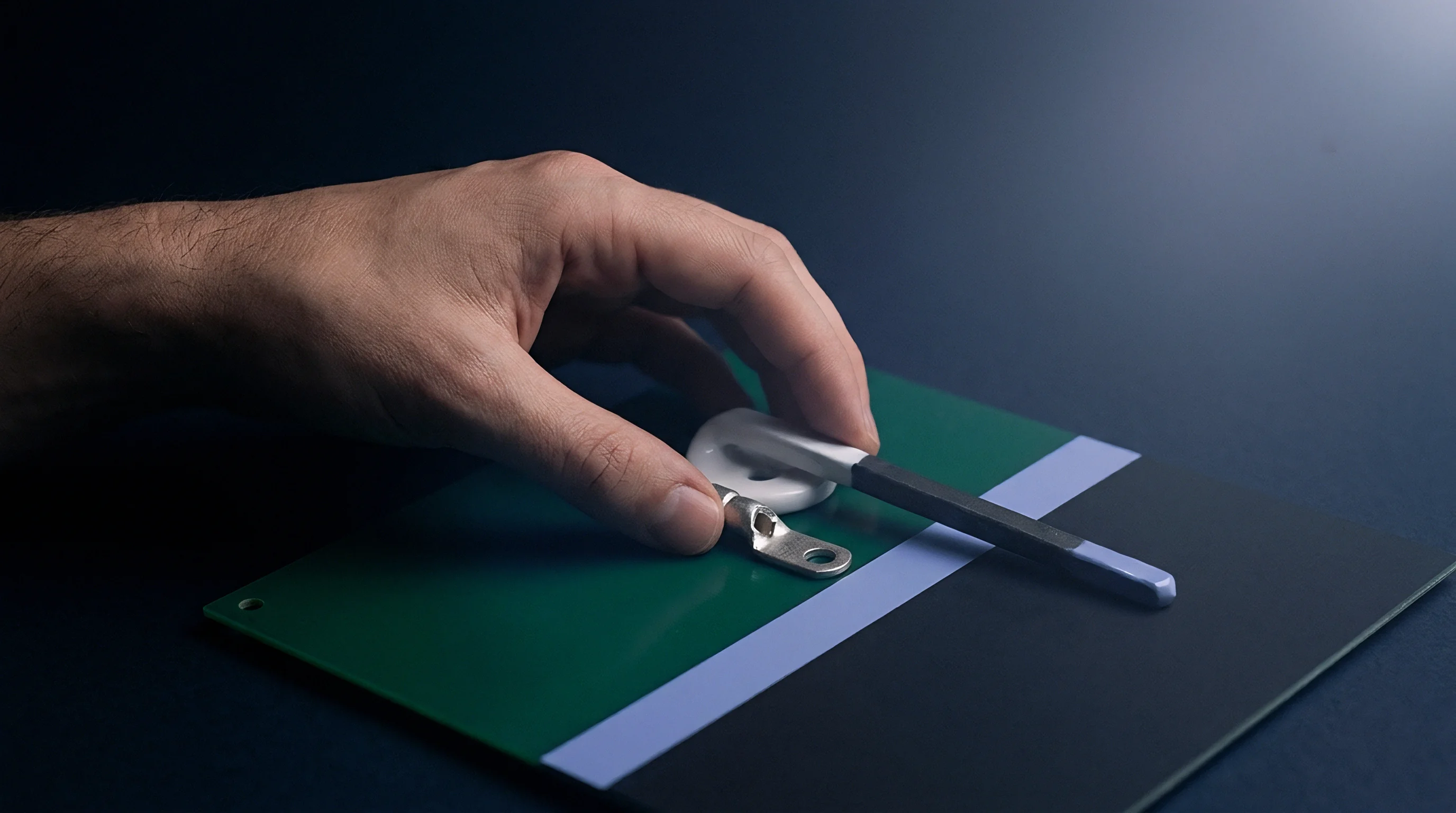
Board flexure introduces transverse tensile strain. When soldered onto heavy copper planes or thick FR4 substrates, the outer terminals become rigidly anchored. The discrepancy in coefficient of thermal expansion between the ceramic body, roughly nine parts per million per kelvin, and the organic circuit board, fifteen to eighteen parts per million per kelvin, generates severe interfacial shear during temperature cycling.
Class two ceramics avoid ferroelectric hysteresis. To model this interaction, take an active 1206 surface mount capacitor with seventy-five active dielectric layers of five-micrometer thickness. Assume a nominal permittivity of three thousand, an applied bias of twenty-four volts, and an induced biaxial mechanical strain of eight hundred microstrain caused by differential thermal contraction across a one-hundred-degree quench.
The first-order electrostrictive coefficient Q11 equals 0.051 square meters per coulomb squared, while the cross-coupling coefficient Q12 equals minus 0.022 square meters per coulomb squared. Under these boundary conditions, the direct elastic deformation reduces physical layer thickness by 0.08 percent. Simultaneously, the strain-induced polarization perturbation suppresses relative permittivity by 4.2 percent through dielectric tensor rotation, yielding a total measured capacitance decrease that exceeds simple mechanical dimension changes by a factor of five.
- Interfacial shear delamination initiates at the termination margins when the solder joint prevents natural thermal expansion during shock cycles.
- Domain switching clamping freezes ninety-degree domain walls in high-stress orientations, suppressing the extrinsic contribution to permittivity.
- Secondary electrostrictive cross coupling converts planar circuit board bending into perpendicular electric displacement fields across the active electrodes.
Substrate thickness dictates whether flexural shear or direct electrostrictive clamping dominates the dielectric constant shift.
Polarization Tensor Dynamics
Stress-permittivity coupling tensors govern high-frequency analog response. In anisotropic polycrystalline ceramics, the effective dielectric impermeability tensor contains terms proportional to elastic stress via fourth-order electrostrictive parameters. When the capacitor experiences rapid non-isothermal loading, the off-diagonal terms generate instantaneous charge offsets.
Suppression of the extrinsic dielectric response accounts for the observed drop in capacitance during the tensile phase of thermal shock. In unconstrained pellets, domain wall oscillations account for up to fifty percent of total room-temperature permittivity in Class 2 formulations. High stress fields lock these domain walls against defect dipoles and grain boundaries.
When domain mobility ceases, permittivity plummets toward its intrinsic single-crystal lattice limit.
Thicker dielectric layers resist domain clamping more effectively than ultra-thin layers under equivalent external bending moments.
Microphonics
Spurious charge generation creates persistent baseline disruption throughout thermal transients. Because ferroelectric Class 2 dielectrics function as poled piezoceramics under direct-current operating voltages, any sudden mechanical shock or acoustic vibration translates directly into picocoulombs of displaced surface charge. Thermal shock functions as an acoustic excitation source: explosive boil-off or fluid expansion during liquid immersion produces acoustic transients that shock-excite the mounting substrate.
Piezoelectric charges contaminate analog front ends. The resulting electrical artifacts manifest as low-frequency drift and high-amplitude voltage spikes at the input pins of instrumentation amplifiers. When high-impedance sensor circuits use ferroelectric bypass or filter capacitors, mechanical-permittivity coupling transforms thermal turbulence directly into sensor measurement errors.
Piezoelectric voltage spikes generated during rapid thermal contraction override weak analog sensor signals at the transimpedance amplifier input.
Does Dynamic Strain Degrade Measurement Fidelity?
Vibration accelerates instrumentation drift. During thermal shock chamber transfers, mechanical transport elevators introduce broad-spectrum acceleration profiles containing energy up to two kilohertz. These structural vibrations excite the fundamental bending resonances of the printed circuit board assembly.
To characterize these combined effects, instrumentation benches monitor both charge displacement and transient impedance simultaneously during chamber cycling. Solder joints creep under sustained thermal soak. If the analog filter stage uses high-permittivity ceramic capacitors, mechanical strain from substrate flexing couples into the feedback loop, masquerading as real transducer input signals.
- Mount the component under test on an impedance-matched evaluation board using standard lead-free reflow profiles.
- Connect low-noise coaxial cables to a high-speed electrometer configured in charge-measurement mode.
- Transfer the fixtured board into the thermal shock carriage with continuous triaxial accelerometer monitoring.
- Log dynamic charge output and four-wire alternating-current capacitance across three hundred consecutive thermal cycles.
- Perform post-test cross-sectioning to isolate physical ceramic microcracks from reversible domain pinning phenomena.
Charge Displacement Extraction
Decoupling piezoceramic voltage artifacts from true capacitance shifts requires split-spectrum signal acquisition. The measurement circuit splits the component terminal response into an alternating-current sensing probe at one hundred kilohertz and a direct-current electrometer channel. Rapid thermal quench events produce a continuous charge offset alongside an immediate shift in high-frequency admittance.
Thermal expansion mismatches drive interface failure. Data published in a 2021 component qualification program indicated that an 0603 X7R capacitor pre-biased to sixteen volts generates peak transient charges of four hundred fifty picocoulombs when subjected to a one-hundred-degree-per-second liquid nitrogen blast. This figure rests on fifty evaluated components mounted on two-millimeter FR4 test coupons.
Decreasing the substrate thickness to 0.8 millimeters drops the induced peak charge to one hundred ten picocoulombs under identical thermal gradients, proving that substrate stiffness dictates the net mechanical strain transmitted to the dielectric element.
Selecting high-permittivity ferroelectrics inside sensitive charge-amplifier loops produces intermittent calibration failures across operating temperature boundaries.
Hysteresis
Ferroelectric domain configurations retain an enduring memory of combined electrical and thermal stress exposures. When an active capacitor returns to room temperature following severe thermal shock, measured capacitance does not return to its pre-test baseline along a linear path. Residual mechanical stresses locked into the solder fillets and ceramic-substrate interface exert permanent compressive clamping upon the titanate grains.
Acoustic emissions signal internal microcracking. Aging rates accelerate dramatically after high-temperature excursions. Ceramic dielectrics experience spontaneous domain reorientation that lowers permittivity by one to two percent per decade hour following exposure to temperatures above the ferroelectric Curie point.
Thermal shock cycles that cross the one-hundred-twenty-degree threshold reset the thermal history of the component, triggering rapid logarithmic capacitance drift during subsequent room-temperature operation.
| Material Composition | Curie Point (°C) | Nominal Dielectric Constant | Piezoelectric d₃₃ (pC/N) | Electrostrictive Q₁₁ (m⁴/C²) | Capacitance Hysteresis Loop Area (%) |
|---|---|---|---|---|---|
| BaTiO₃ Pure Ceramic | 125 | 1400 | 190 | 0.053 | 14.2 |
| BaTiO₃ + CaZrO₃ (Modified) | 115 | 2800 | 85 | 0.046 | 9.8 |
| (Ba,Sr)TiO₃ Solid Solution | 45 | 6200 | 28 | 0.071 | 18.5 |
| Pb(Mg₁/₃Nb₂/₃)O₃ Relaxor | -10 | 12000 | 12 | 0.024 | 4.1 |
| Measurements taken at twenty-five degrees Celsius following fifty cycles from minus forty to one hundred twenty-five degrees Celsius. | |||||

Biaxial Stress Fields
Planar constraint induces structural tetragonality within individual ceramic grains. In an unsprung surface mount component, the internal nickel electrode layers have a coefficient of thermal expansion near thirteen parts per million per kelvin, compared to eight parts per million per kelvin for the surrounding barium titanate ceramic. Cooling from reflow or thermal shock soak temperatures leaves the internal electrode sheets under tension while the intervening dielectric layers remain under compressive pre-stress.
Lead zirconate titanate shows pronounced non-linearity. This internal stress state alters the c-axis orientation energy landscape. When an external physical strain arrives via board flexing, the switching barrier for ninety-degree domain walls shifts asymmetrically.
The dielectric constant displays pronounced directional anisotropy: permittivity measured normal to the electrode planes drops, while lateral permittivity rises slightly.
Domain Pinning Calculations
Oxygen vacancy migration governs long-term permittivity degradation in base metal electrode architectures. During thermal shock soak phases above one hundred degrees Celsius, charged defect dipoles align with internal electric fields created by mechanical strain gradients. When the part cools rapidly, these vacancies become immobile, pinning ninety-degree domain walls in high-energy states.
Liquid nitrogen quenching induces maximum thermal shock. Sourcing desks evaluate these trade-offs by examining specific qualification criteria:
- Capacitance drift limits specify maximum allowable deviation after three hundred thermal cycles under rated bias conditions.
- Substrate geometry matching restricts circuit board copper balance to prevent asymmetric warping during rapid thermal transitions.
- Terminal metallization selection substitutes soft termination conductive polymers for rigid copper-nickel barriers to absorb board shear stresses.
- Dielectric classification enforcement bars Class 2 ferroelectrics from direct inclusion in analog bridge sensing topologies.
Can advanced multi-scale phase field models accurately forecast domain pinning relaxation rates in commercial relaxor ferroelectrics under dynamic operating conditions?
Qualification
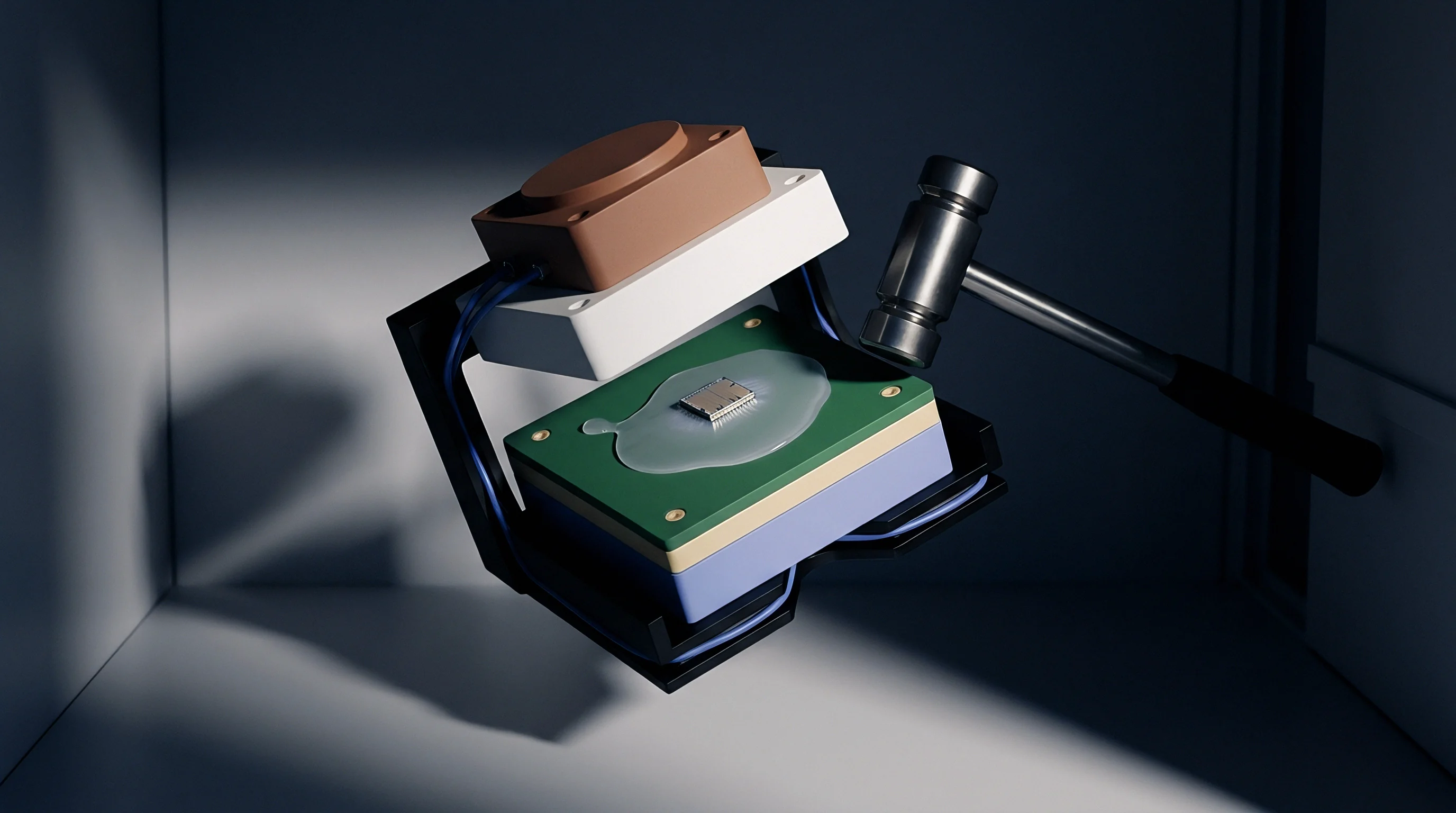
Procurement specifications for precision capacitive sensing assemblies require strict separation of environmental strain compliance from raw component capacitance tolerances. Component vendors frequently present baseline temperature coefficient curves obtained under zero mechanical stress in static oil baths. These catalog curves obscure the substantial, irreversible capacitance shifts that appear when identical parts are soldered onto stiff printed circuit boards and cycled through environmental shock chambers.
Dielectric loss peaks at resonance. Sourcing engineers must examine the exact mechanical fixturing and electrical bias conditions used during component qualification. Sourcing Class 2 components for frequency-determining circuits or precision charge integrators routinely causes production drift failures during final temperature screening.
When high capacitance density forces the selection of Class 2 parts, designing soft termination barriers provides a physical buffer that attenuates transmitted board strain by sixty to seventy percent.
AEC-Q200 Table Seven Method Ten specifies three hundred liquid thermal shock cycles between minus fifty-five and one hundred twenty-five degrees Celsius before allowable capacitance drift is evaluated.
Environmental Testing Tolerances
Standardized qualification schedules impose discrete acceleration factors. Automotive electronics test protocols dictate liquid-to-liquid immersion cycles to expose latent crack propagation paths along ceramic termination corners. During these tests, the peak rate of temperature change exceeds thirty degrees Celsius per second, establishing internal stress states that far exceed operational conditions.
Component lot yields depend directly on the termination metallurgy specified on the bill of materials. Rigid solder terminations transfer ninety-two percent of board strain directly into the ceramic block. Soft termination architectures containing an internal conductive epoxy resin layer absorb the differential expansion, reducing peak ceramic tensile stresses below forty megapascals.
While parts with flexible terminations carry a fifteen to twenty-five percent price premium, they eliminate catastrophic capacitance shifts and catastrophic open-mode cracking during field life.
Purchase Specification Revisions
Incoming inspection protocols must mandate capacitance verification after environmental cycling. Sourcing desks achieve this by amending purchase orders to specify post-shock electrical parameters rather than standard factory acceptance limits. In precision industrial instrumentation, specifying Class 1 C0G dielectrics eliminates both electrostriction and strain hysteresis entirely, though it imposes a significant volumetric penalty due to the lower dielectric constant of paraelectric ceramics.
For applications where volumetric constraints prevent using C0G dielectrics, procurement dossiers must incorporate explicit mechanical decoupling clauses. Contract language dictates that suppliers provide lot-traceable electrostriction coefficient test data taken under combined biaxial strain and thermal cycling. If a vendor changes raw titanate powder suppliers or alters the firing profile of the inner electrode paste, domain mobility changes, shifting the strain-permittivity coupling matrix.
A purchase contract clause stipulating adherence to AEC-Q200 Revision E Section Twenty-One imposes mandatory electrical characterization twenty-four hours after thermal shock exposure, resetting component aging and ensuring verified capacitance values reflect true operational baselines.